The Never-Ending List
Tasks accumulate faster than they can be completed. Seeing everything you haven't done creates overwhelm, not clarity.
Understanding the psychology of mental overload, and why the way we manage tasks might be making it worse.
Psychologists call it the Zeigarnik effect: our minds are drawn to incomplete tasks. We remember unfinished business far more vividly than completed work.
It is as if our brain opens a tab for every pending item and refuses to close it until the task is done. In modern life, we carry dozens of these open loops:
"The exhaustion you feel often comes not from the work you did, but from the mental weight of everything you are trying to remember."
Our working memory is limited. Research suggests we can hold only about four to seven items in active attention at once. When we try to track more, something gives way.
The symptoms are familiar:
This is not laziness or poor time management. It is cognitive overload: the natural consequence of asking our minds to hold more than they were designed to carry.
The humble to-do list seems like the obvious solution. But for many people, to-do lists become another source of anxiety.
Tasks accumulate faster than they can be completed. Seeing everything you haven't done creates overwhelm, not clarity.
Items linger past their due dates, acquiring a red badge of failure. The list becomes a record of disappointment.
Complex systems require time to maintain. The overhead of managing the system competes with actually doing the work.
Reminders that feel like demands. Apps that gamify productivity with streaks, adding pressure instead of reducing it.
A system that truly reduces mental load should feel different:
Put something down and know it will be there when you need it, without thinking about it meanwhile.
Capturing a thought should take seconds, not minutes of categorization and scheduling.
It should not demand attention unless you ask it to. No guilt, no pressure, no manipulation.
Changing your mind, rescheduling, or ignoring something should be easy and judgment-free.
"The best task system is one you forget is there, until you need it."
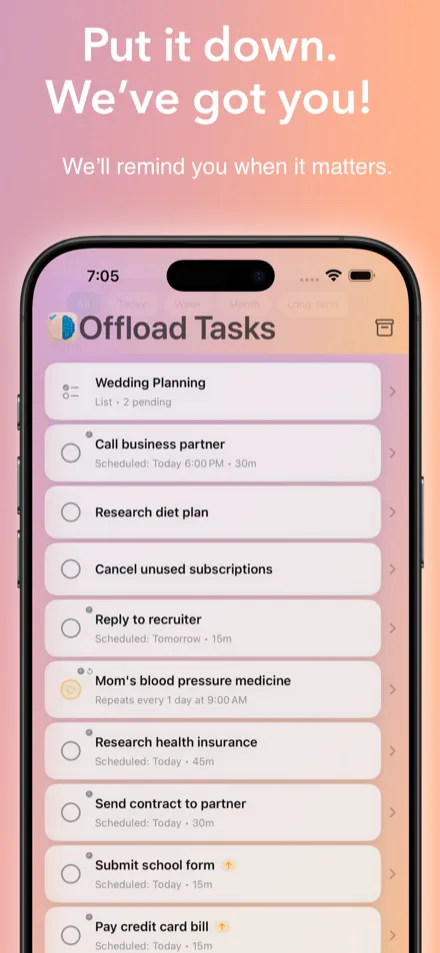
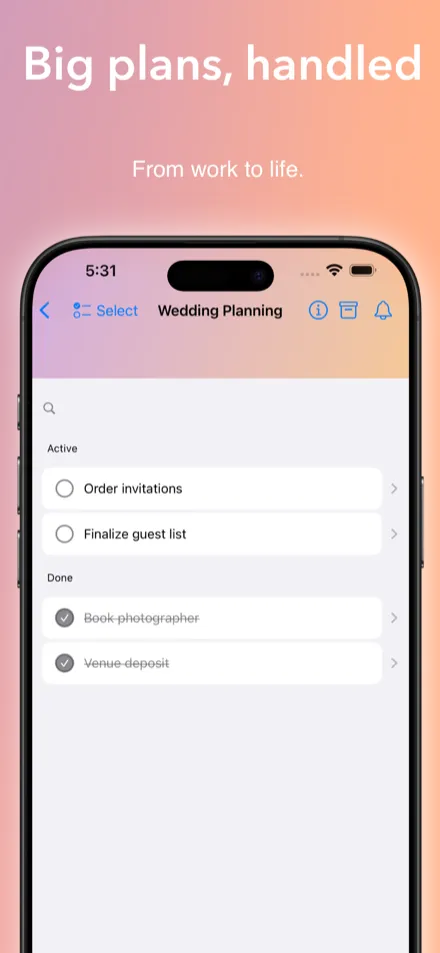
Offload was built specifically to address these problems.