Decision Fatigue
Every time you choose what to work on, you spend mental energy. By afternoon, you are too depleted to make good choices.
When everything feels urgent and important, how do you decide what to do first? The anxiety of conflicting demands is exhausting.
You have a deadline at work. Your family needs you. A friend asked for help. There is a bill that is due. The car needs an oil change. Your inbox is overflowing.
Everything is important. Everything feels urgent. And you only have one you, with a limited number of hours.
This is the reality of modern life: competing priorities that all demand attention at once. The stress comes not just from the work itself, but from the constant mental effort of deciding what to do next.
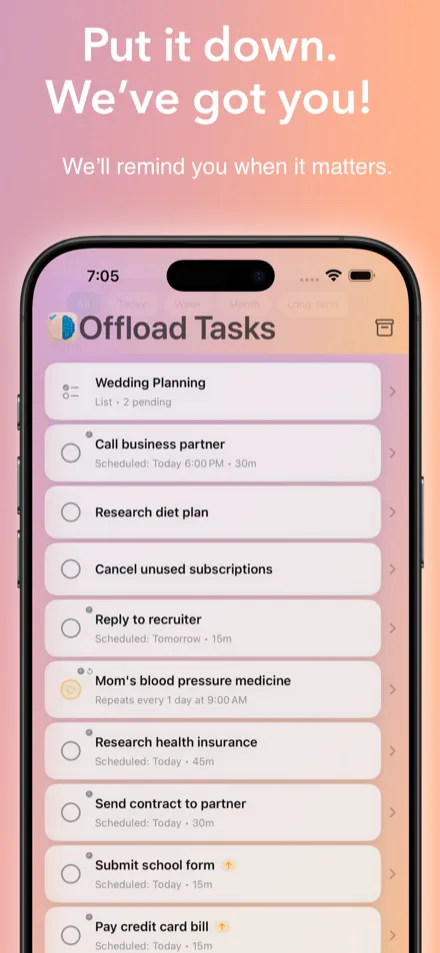
Every time you choose what to work on, you spend mental energy. By afternoon, you are too depleted to make good choices.
Jumping between tasks based on urgency means never getting into flow. Each switch costs time and cognitive resources.
Whatever you are doing, something else is not getting done. This creates a constant background guilt that never fully resolves.
When everything is urgent, you spend your life responding instead of choosing. Your priorities get set by whoever shouts loudest.
"You cannot do everything. Accepting this is not failure, it is wisdom."
Most task apps try to solve this with priority levels: High, Medium, Low. Or with elaborate systems like Eisenhower matrices and GTD contexts.
In theory, these help you decide. In practice, they often add complexity without clarity. You still have ten "high priority" items competing for attention. Now you just spent extra time categorizing them.
The real problem is not that you cannot prioritize. It is that you have committed to more than is possible.
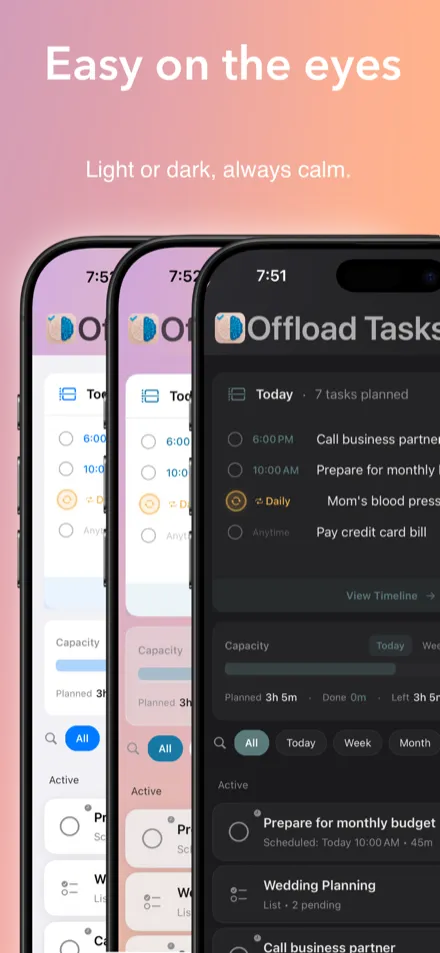
Before you can decide what to do first, you need to see what you have actually committed to.
Offload shows your capacity: how much you have planned for today, this week, this month. This is not about cramming more in. It is about recognizing when you have already planned too much.
When you can see that you have committed to twelve hours of work for an eight-hour day, the choice becomes clearer. Something has to move. The question shifts from "what should I do first?" to "what can realistically wait?"
The most powerful thing Offload can do is help you accept what is actually possible.
This is not about giving up or lowering standards. It is about being honest with yourself about time and energy. When you stop pretending you can do everything, you can start making real choices about what matters most.
Some things will not get done today. Some things will not get done this week. And that is not failure. That is just reality, acknowledged clearly so you can stop carrying the weight of impossible expectations.
See at a glance whether you have planned too much. Overcommitment becomes obvious before it becomes overwhelming.
Move tasks to another day with one tap. No guilt, no friction. Plans change, and the system adapts.
No complex priority systems to maintain. Just tasks, organized however makes sense to you.
Schedule things for today, this week, or leave them unscheduled. Not everything needs a deadline.
The app does not tell you what to do first. It shows you what exists and trusts you to decide.
No urgent badges, no red warnings. The visual design supports clear thinking, not panic.
"Clarity about what you cannot do is just as valuable as knowing what you can."
Try an approach that helps you accept limits instead of denying them.