Analysis Paralysis: The Hidden Cost of Overthinking
When you have too many things to do, the hardest part is not doing them. It is deciding which one to do first.
Frozen by Options
You sit down to work. You have time, you have energy, and you have a list of things that need to get done. By all accounts, this should be the moment you have been waiting for. But instead of starting, you stare at the list.
Should you begin with the urgent email, or the report that is due tomorrow? The quick errand might be a good warm-up, but the bigger project feels more important. Maybe you should reorganize the list first. Maybe you should check if anything new has come in since this morning. Maybe you should think about priorities before committing to anything at all.
Twenty minutes pass. You have not started a single task. You have spent more time deciding what to do than it would have taken to finish most of the things on your list. The paradox is maddening: you have a full list and available time, yet you are completely stuck. Not because the work is hard, but because choosing where to begin feels impossible.
This is analysis paralysis. It is one of the most common and least discussed barriers to getting things done. Not a lack of motivation. Not a lack of discipline. An invisible overload of decisions that freezes you in place before you even begin.
The Psychology of Too Many Choices
In 2000, psychologists Sheena Iyengar and Mark Lepper published a study that changed how we understand decision-making. They set up a tasting booth at a grocery store and offered shoppers samples of jam. On some days, the booth displayed 24 varieties. On other days, it displayed only 6.
The large display attracted more people. But here is the critical finding: shoppers who saw 24 options were one-tenth as likely to actually buy a jar compared to those who saw only 6. More choices led to more browsing but dramatically less action. The abundance of options did not empower people. It overwhelmed them into doing nothing.
Psychologist Barry Schwartz expanded on this phenomenon in his influential work on the paradox of choice. He demonstrated that as the number of options increases, several things happen simultaneously. The cognitive effort required to evaluate and compare rises sharply. The expectation for the quality of the final decision increases, because with so many options available, surely one of them must be perfect. And the potential for regret grows with every path not taken, every option left unchosen.
The result is a cruel irony: the more options you have, the less capable you become of choosing any of them. And even when you do finally choose, you feel worse about your decision than you would have with fewer alternatives.
Now apply this to your task list. A long, undifferentiated list of things to do is not a plan. It is a choice overload problem disguised as organization. Every time you look at it, your brain is being asked to evaluate, compare, and select from dozens of competing options, each of which feels roughly as important and urgent as the others. The list that was supposed to help you get organized is actually the thing preventing you from getting started.
Why Your Brain Gets Stuck
Decision-making is not free. It draws from the same limited pool of cognitive resources that you use for self-control, focused attention, and complex reasoning. Psychologist Roy Baumeister's research on ego depletion demonstrated that the act of making decisions, even small and seemingly trivial ones, measurably reduces your capacity for subsequent decisions and self-regulation.
This is decision fatigue, and it explains why analysis paralysis tends to get worse as the day goes on. Each choice you make, from what to eat for breakfast to how to phrase an email to which meeting to prioritize, quietly drains the same reservoir. By the time you sit down to face your task list, you may have already spent much of your decision-making budget on things you barely noticed.
When you face a long list of undifferentiated tasks, your brain must perform a complex series of evaluations for each one. What is the importance of this task? How urgent is it? How much effort will it require? What happens if I postpone it? Which tasks depend on which other tasks? Is there a better order to do them in? Would it be smarter to batch certain types of work together?
Multiply those evaluations by twenty or thirty tasks, and the cognitive load becomes enormous. Your brain is running a complex optimization problem with incomplete information and no clear criteria for what counts as the right answer. The rational response to this impossible calculation is often to do nothing at all. To defer the decision, to check something easy like email or social media, or to simply freeze in place while the minutes tick by.
This is not laziness. It is not a character flaw. It is a cognitive system that has been overwhelmed by the sheer number of decisions it is being asked to make before any real work has even begun.
"The enemy of done is not laziness. It is the inability to choose where to start."
The Overthinking Loop
Analysis paralysis is not a single moment of indecision. It is a self-reinforcing cycle that feeds on itself and grows stronger with each revolution.
The loop begins when you review your tasks and try to pick the right one. You weigh the options, consider the trade-offs, and begin to second-guess yourself. Maybe you should do the other thing first. You re-evaluate. You still cannot decide. Time passes. Now you feel guilty about the time you have already wasted, which adds emotional pressure to the decision. The pressure makes the choice feel even more consequential, because now you need to pick the right task to justify the time already lost.
The stakes rise. The decision gets harder. More time passes. You review the list again, hoping something will jump out at you. Nothing does. The guilt deepens. You start to feel frustrated with yourself. The frustration clouds your thinking further. The cycle tightens.
This loop consumes enormous mental energy while producing absolutely nothing. It is the worst possible combination: high cognitive cost with zero output. And the longer it runs, the more exhausted and discouraged you become, which makes the next attempt to decide even harder to face. Many people mistake this experience for a motivation problem. They think they need to try harder or develop more discipline. But the issue is not willpower. It is a decision architecture problem. The environment is asking too much of the decision-making system, and the system is responding the only way it can: by stalling.
Breaking Through
If analysis paralysis is fundamentally a problem of too many decisions, then the solution is not to think harder. It is to reduce the number of decisions you need to make. Not through willpower, but through structure.
Reduce your visible choices. The most effective intervention is also the simplest: stop looking at the entire list. Research on choice overload consistently shows that fewer visible options lead to faster and more confident decisions. If you have thirty tasks, you do not need to see all thirty when deciding what to do right now. You need to see three or four. The rest should be stored somewhere reliable but kept out of sight until their time comes.
Pre-commit to a small daily list. Make your decisions about what to do today at a specific, dedicated time, ideally the evening before or first thing in the morning, when your decision-making resources are fresh. Once the list is set, the question shifts from "What should I do?" to "What is next on my list?" The second question requires almost no cognitive effort. The decision has already been made. You are simply executing.
Use time-based constraints, not priority-based ones. Elaborate priority systems with multiple levels, color codes, and urgency matrices create more decisions, not fewer. Each task becomes a miniature puzzle: is this a P1 or a P2? Is it urgent-important or important-not-urgent? Instead, ask a simpler question: "What can I realistically do today given the time I have?" This single constraint naturally limits your list and eliminates the need for complex ranking systems entirely.
Accept rough equivalence. Here is a truth that perfectionism obscures: for most of the tasks on your list, the difference between doing Task A first and Task B first is negligible. The time you spend trying to determine the optimal order almost always exceeds any efficiency you might gain from finding it. Any reasonable choice is better than no choice. Progress in any direction is better than standing still while you search for the perfect direction.
Start with the smallest action. When the loop is running and you cannot break free, choose the task that requires the least commitment. A two-minute email, a single phone call, one small step on a larger project. Momentum is real. Once you are in motion, the paralysis tends to dissolve on its own. The first task does not need to be the most important one. It just needs to be the one that gets you moving.
"You do not need a better prioritization system. You need to see fewer things at once."
How Offload Cuts Through the Noise
Offload was designed with a specific understanding: the biggest threat to getting things done is not forgetting what needs doing. It is being confronted with everything at once and expecting your brain to sort it all out in the moment.
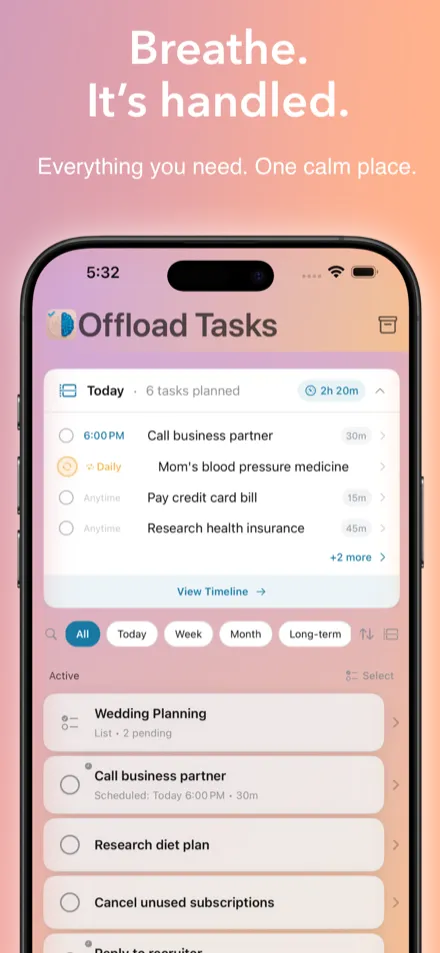
Capacity-limited daily view. When you open Offload, you do not see your entire backlog. You see what you committed to for today, limited by a daily capacity you set yourself. This is not a restriction. It is a relief. Instead of facing an overwhelming wall of tasks and wondering where to begin, you see a short, manageable list that has already been decided. The question of what to work on is already answered. You just start.
Pre-commitment during planning. Offload encourages you to plan your day during a calm, deliberate moment rather than in the heat of the morning rush. When you assign tasks to a specific day, you are making your decisions when your cognitive resources are available for decision-making, not when they are needed for actual work. By the time you sit down to execute, the deciding is done.
No priority matrices. There are no elaborate color-coded urgency levels. No multi-axis importance graphs. No priority scores that require their own decisions to assign. Offload keeps things simple because every layer of complexity you add to a task system is another decision you have to make before you can start working. Simplicity is not a limitation. It is the entire point.
Calm, focused interface. When you open the app, the experience is quiet. There are no screaming badges, no red counters, no visual noise competing for your attention and pulling you into evaluation mode. The app presents your commitments and then gets out of the way. This matters because a cluttered, information-dense interface triggers the same evaluation-and-comparison behavior that causes paralysis in the first place.
The philosophy is straightforward: make the decisions once, during planning. Then trust the plan and execute. By separating the moment of deciding from the moment of doing, Offload ensures that you never have to stare at a long list wondering where to begin.
Progress, Not Perfection
Analysis paralysis thrives on the illusion that there is a perfect choice hiding somewhere in your list, and that if you just think about it long enough, you will find it. But for the vast majority of daily tasks, there is no perfect order. There is no optimal sequence that unlocks dramatically better outcomes. There is only done and not done.
The person who picks a reasonable task and starts working will always outperform the person who spends an hour searching for the ideal task to start with. Progress is not about making perfect decisions. It is about making any decision and then following through.
The best decision is often simply the next one. Not the most strategic one, not the highest-impact one, but the one that gets you moving. Because once you are in motion, the clarity that felt impossible while you were standing still begins to arrive on its own. You finish something, and the next thing becomes obvious. You cross off a task, and the mental space it occupied becomes available for focus and forward momentum.
The goal is not to optimize your task list into a perfect sequence. The goal is to get things out of your head, commit to a realistic plan, and move through that plan without the constant friction of re-evaluating every step. When the deciding is done in advance and the doing happens in the moment, the overthinking loop has nothing to grab onto. You are simply in motion, one task at a time, with a quiet mind and a clear next step.
Stop Overthinking, Start Offloading
Offload shows you only what matters today. No endless backlog, no priority matrices. Just a calm, focused view of what you committed to.