Decision Fatigue
Every task on your list represents a decision: should I do this now, later, or not at all? When too many of those micro-decisions pile up, your ability to choose degrades. Eventually, you stop choosing.
When you have so many things to do that you cannot start any of them. It is not a flaw. It is a signal.
Task paralysis is the experience of being unable to start anything when you have too many things demanding your attention. You stare at your list. You know things need to happen. But you cannot pick one and begin.
It is not about the difficulty of any single task. It is about the sheer volume of open loops competing for your attention at the same time. Your brain tries to evaluate all of them simultaneously, and when it cannot determine the right starting point, it stops trying altogether.
This is one of the most common and least understood forms of overwhelm. You are not stuck because you are incapable. You are stuck because there are too many doors open at once and your mind cannot choose which one to walk through.
Every task on your list represents a decision: should I do this now, later, or not at all? When too many of those micro-decisions pile up, your ability to choose degrades. Eventually, you stop choosing.
When input exceeds processing capacity, the brain does not speed up. It slows down. This is a protective mechanism, not a malfunction. Your nervous system is trying to shield you from overload.
If you feel you need to start with the "right" task, you may never start at all. Perfectionism turns every decision into a high-stakes evaluation, raising the cost of choosing wrong.
When everything feels equally urgent, nothing stands out. Without a clear signal for what matters most right now, your brain cycles endlessly through the options without landing on one.
"The problem is not laziness. The problem is having too many open doors and no clear path through."
Task paralysis is a form of stress response. When your brain encounters more demands than it can process, it does not push through. It shuts down. This is the same freeze mechanism that activates when any system faces more input than it can handle.
You might feel it as blankness, restlessness, or a strange mix of urgency and inaction. You know things need to happen, but your body will not cooperate. You might scroll your phone, reorganize your desk, or switch between tasks without completing any of them.
This is not a character flaw. It is your brain protecting itself from cognitive overload. The freeze response exists because trying to process everything at once would be worse than processing nothing. Your nervous system is choosing the lesser harm.
Understanding this matters because the solution is not willpower. You cannot force your way through a freeze response. What you can do is change the conditions that triggered it: reduce the number of things competing for your attention until your brain has a clear enough path to move forward.
The antidote to task paralysis is not motivation. It is reduction. When you are frozen, the path forward is not to try harder. It is to see less.
Start by externalizing. Get every task, thought, and worry out of your head and into a system you trust. This alone can reduce the mental noise enough to create movement. Your brain does not need to hold everything if something else is holding it for you.
Then simplify. Hide the full list. Narrow your view to one or two things. The goal is not to find the perfect starting point. The goal is to reduce the options until choosing becomes easy.
Pick one thing. Any thing. Start there. Once you are in motion, the paralysis loosens. The first step does not need to be the right step. It just needs to be a step.
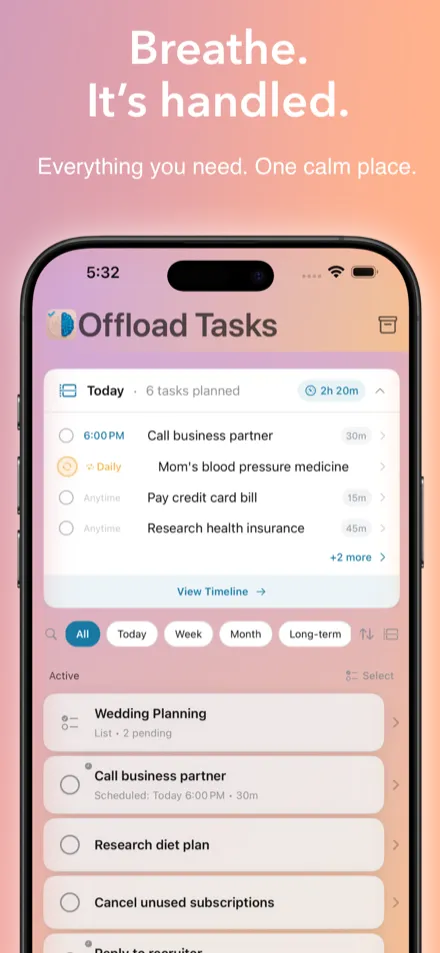
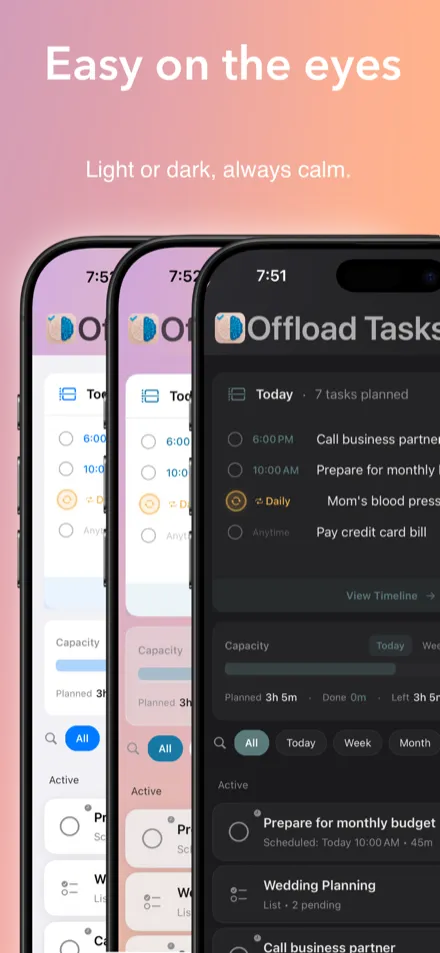
Offload uses capacity-based planning to show you only what fits your day. Instead of an endless list, you see a manageable set of tasks that respects your real limits.
Get thoughts out of your head in seconds. No required fields, no forced categories. Just type and close. The faster you can externalize, the sooner the mental pressure lifts.
Offload does not force you to rank or prioritize. There are no urgent labels, no color-coded severity levels. Every task is just a task, waiting calmly until you are ready.
Reminders in Offload are opt-in and softly phrased. They exist to help you remember, not to pressure you into action. You can silence them any time without guilt.
"You do not need to do everything. You need to start one thing."
Offload helps you start by helping you set things down. One task at a time, no pressure.