Why Procrastination Is an Anxiety Problem, Not a Laziness One
The reason you avoid things has almost nothing to do with motivation. It has everything to do with how the task makes you feel.
The Shame of Putting Things Off
It is Tuesday evening. There is a report you were supposed to start on Monday. You have known about it for a week. The deadline is Thursday, and you have not written a single word. Not because you forgot. You have thought about it constantly. It has followed you into the shower, onto the couch, into conversations where you were supposed to be listening but your mind kept circling back to the same sinking feeling: you still have not started.
You opened the document this morning. You stared at the blank page for four minutes, then closed it and cleaned the kitchen instead. After that, you organized your email inbox. Then you did laundry. Then you researched a vacation you are not going to take. You did everything except the one thing that actually mattered, and with every passing hour, a familiar narrative tightened around you like a belt: you are lazy. You are undisciplined. Other people manage to just sit down and do things. Something is fundamentally wrong with you.
This story is so familiar to so many people that it has become a kind of identity. "I'm a procrastinator." People say it with a shrug, the way they might say they are bad at math. As though it is a fixed trait. A deficiency of character baked in at birth.
But the growing body of research on procrastination tells a very different story. One that has nothing to do with laziness, and everything to do with anxiety.
What Procrastination Actually Is
For most of the twentieth century, procrastination was treated as a time management problem. The assumption was straightforward: people who procrastinate do not know how to organize their time. Give them a planner, a deadline, a system, and the problem resolves itself.
Dr. Tim Pychyl, a professor of psychology at Carleton University who has studied procrastination for over two decades, has dismantled this assumption thoroughly. His research demonstrates that procrastination has almost nothing to do with time and almost everything to do with emotion. Procrastination is an emotion regulation problem, not a time management problem.
When you procrastinate, you are not making a rational calculation about how best to spend your hours. You are doing something far more primitive. A task in front of you triggers a negative emotional response: anxiety about whether you can do it well, boredom at the tedium involved, self-doubt about your ability, fear of being evaluated, or dread about the sheer size of what needs to be done. Your brain, doing exactly what it evolved to do, reaches for immediate relief from that discomfort. You switch to something that feels safer. The email. The kitchen. The phone. Anything that makes the feeling go away, even temporarily.
Dr. Fuschia Sirois, a professor of psychology at Durham University, has extended this understanding with her own research. She has shown that procrastination is fundamentally a failure of emotional self-regulation, where we sacrifice our long-term goals in favor of short-term mood repair. We are not choosing to be irresponsible. We are choosing to stop feeling bad right now, in this moment, because the present discomfort feels more real and more urgent than the future consequence.
This reframing matters enormously. If procrastination is a character flaw, the solution is shame and force. If procrastination is an emotional regulation problem, the solution is entirely different.
"Procrastination is not a time management problem. It is an emotion management problem."
The Anxiety-Procrastination Cycle
What makes procrastination so persistent is not the initial avoidance. It is what happens after. Procrastination feeds itself through a vicious cycle that escalates with every rotation, and understanding this cycle is essential to breaking free from it.
It begins when a task triggers anxiety. Perhaps you need to prepare a presentation for work. The thought of it activates something uncomfortable: what if it is not good enough, what if people judge you, what if you blank out in front of the room. The anxiety is unpleasant, so you set the task aside. You scroll through your phone instead. And for a brief moment, the anxiety recedes. You feel relief.
But that relief is borrowed time. Because now, layered on top of the original anxiety about the presentation, a new emotion arrives: guilt. You know you should have started. You told yourself you would. And you did not. The guilt is uncomfortable, so your brain begins to construct a story to explain the gap: maybe you work better under pressure, maybe you will feel more inspired tomorrow, maybe it is not actually that important. These are not strategies. They are painkillers.
The next day, the task is still waiting. But now it carries its original emotional weight plus the added burden of a day lost to avoidance, plus the shame of having failed to follow through, plus the growing urgency of a deadline that is now one day closer. The emotional cost of engaging with the task has increased, which means the threshold for starting has gone up, which means avoidance is even more likely.
The cycle looks like this: task triggers anxiety, avoidance provides temporary relief, guilt and shame build, anxiety about the task increases, starting becomes harder, more avoidance follows. Each loop through the cycle raises the emotional barrier. What began as mild discomfort becomes dread. What began as a manageable task becomes a monster in your mind, growing larger not because the work itself changed, but because your emotional relationship to it deteriorated with every day of delay.
This is why procrastinators consistently report that the hardest part is not doing the work. It is starting. Once they begin, the task is usually manageable, often even enjoyable. But the wall of negative emotion that stands between them and the first step grows taller with each act of avoidance.
Why Willpower Is Not the Answer
The most common advice for procrastination is some variation of "try harder." Use discipline. Set stricter deadlines. Hold yourself accountable. Punish yourself for not following through.
These approaches all share the same assumption: that the problem is a lack of willpower and the solution is to apply more force. But if procrastination is an emotional problem, then willpower-based solutions are addressing the wrong condition entirely. It is like prescribing a louder alarm clock for insomnia. The volume was never the issue.
Willpower is a finite cognitive resource. Research has shown that self-control depletes over the course of a day, especially when you are already managing stress, making decisions, or regulating other emotions. Asking someone to power through task anxiety with sheer will is asking them to spend a currency they may have already exhausted by lunchtime.
Worse, willpower-based approaches actively reinforce the shame cycle. When you set a strict deadline and miss it, you do not just fail to complete the task. You fail to meet the standard you set for yourself. The shame deepens. The self-doubt grows. And the next attempt requires even more willpower to overcome a now-larger emotional barrier. Force begets resistance. Discipline applied to an emotional wound only makes the wound hurt more.
The answer is not more force. It is less friction.
Breaking the Cycle
If procrastination is driven by emotion, then the solution must address the emotion. Not by suppressing it or overpowering it, but by reducing its intensity so that action becomes possible without a fight. Research and clinical practice converge on several approaches that work precisely because they lower the emotional cost of engagement.
Reduce the emotional cost of starting. The biggest barrier is the gap between "not started" and "started." Your brain is not reacting to the first five minutes of work. It is reacting to the full imagined weight of the project, the possibility of failure, the judgment of others, every worst-case scenario it can conjure. The antidote is to make the first step absurdly small. Not "write the report" but "open the document and type one sentence." Not "clean the entire house" but "pick up the three things on the coffee table." When the first step is tiny enough, the emotional activation cost drops below the threshold that triggers avoidance. And once you are in motion, the task almost always feels less threatening than it did from the outside.
Externalize the task. A task that lives only in your head grows heavier with each hour it stays there. It becomes entangled with all the emotions surrounding it: the guilt of not starting, the fear of the outcome, the shame of past failures. Writing it down, moving it from your mind to an external system, separates the task from its emotional weight. On a screen or a page, the task is just words. It has edges, limits, a concrete shape. It is a thing to be done, not a shapeless cloud of dread. The act of externalization also reduces the cognitive burden of remembering, freeing up mental resources that can be used for emotional regulation instead.
Separate planning from doing. One hidden reason tasks feel overwhelming is that we try to plan and execute simultaneously. We sit down to work and immediately face a cascade of decisions: where to start, what to include, how to approach it, what the final result should look like. Each decision is a micro emotional event, a tiny fork in the road where self-doubt can creep in. Instead, plan first, separately, when the pressure is off. Break the task into steps. Write them down. Then when it is time to act, there is no thinking required. You just follow the plan you already made. The emotional cost of execution drops dramatically when the cognitive cost has already been paid.
Use gentle time-based nudges, not guilt-based deadlines. Deadlines that carry consequences amplify anxiety, which amplifies avoidance. A gentle nudge, a calm reminder that a task is waiting for you, lowers the emotional temperature entirely. It says "this is here when you are ready" rather than "you are running out of time." The difference in emotional impact is the difference between a hand on your shoulder and a finger in your chest.
Practice self-compassion. Dr. Sirois has found that self-compassion is one of the most powerful antidotes to procrastination. When you respond to your own avoidance with understanding rather than criticism, you break the shame cycle at its source. You are not letting yourself off the hook. You are removing the emotional penalty that makes it harder to try again. People who treat themselves with compassion after procrastinating are more likely to re-engage with the task sooner, not less likely. Gentleness, it turns out, is more motivating than punishment.
"You do not need more discipline. You need less emotional friction."
How Offload Approaches This Differently
Most productivity tools are built on an assumption that does not hold for people caught in the procrastination-anxiety cycle. They assume the problem is organizational and that the solution is more structure, more tracking, more accountability. For someone whose avoidance is driven by emotion, these features do not help. They add friction, and friction is exactly what feeds the cycle.
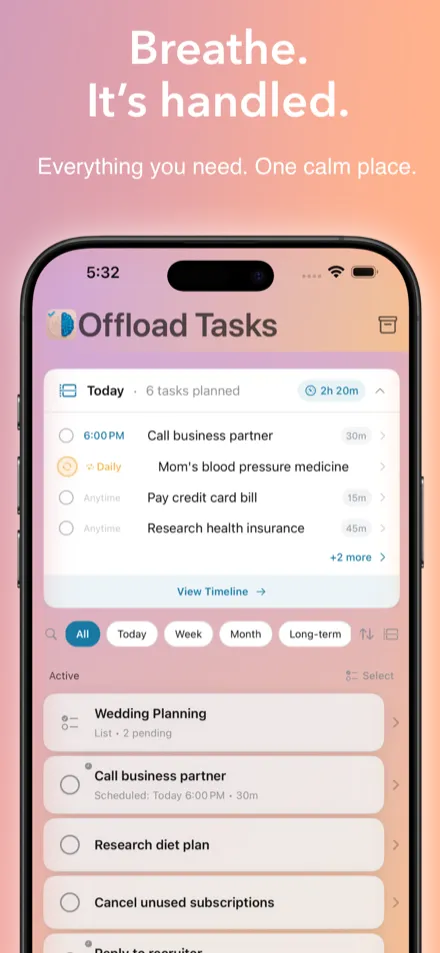
Instant capture reduces emotional weight. When a task is sitting in your head, it is not just a task. It is a task wrapped in worry, tangled with self-judgment, growing heavier by the hour. The moment you capture it in Offload, something shifts. The thought moves from the anxious, recursive space of your mind to a calm, neutral place. The task is still there, but it is lighter now. It is just words on a screen, not a weight on your chest. And because capturing a thought takes only seconds, with no required fields, no forced decisions about categories or due dates, there is almost no emotional barrier to getting it out of your head.
No overdue shame. Offload does not mark tasks as overdue. It does not turn them red. It does not count the days you have been avoiding something and display that number like a scoreboard of failure. Because shame does not motivate action. Shame feeds avoidance. If a task was planned for yesterday and it did not happen, Offload simply carries it forward. No judgment. No punishment. The task is still here, patient and unchanged, ready for whenever you are.
Calm reminders instead of alarming notifications. The notifications from Offload are designed to feel like a gentle tap on the shoulder, not a fire alarm. They bring tasks back to your attention without implying that you have failed by not doing them yet. This matters profoundly, because the emotional tone of a reminder determines whether it opens the door to action or slams it shut with another wave of anxiety.
Capacity awareness prevents the overcommitment that fuels avoidance. One of the hidden drivers of procrastination is having too much on your plate. When everything feels urgent and the list is impossibly long, the emotional cost of starting anything skyrockets, because no matter what you choose, you are neglecting something else. Offload helps you see how much you have planned for a given day, making it easier to keep your commitments realistic. Fewer commitments means less overwhelm. Less overwhelm means less avoidance. The math is straightforward.
A Signal, Not a Character Flaw
The most important shift you can make in your relationship with procrastination is this: stop treating it as evidence that something is wrong with you, and start treating it as information.
When you procrastinate, your nervous system is telling you something. It is saying that this task carries an emotional cost that feels too high right now. Maybe the cost is fear of failure. Maybe it is perfectionism, the gap between what you imagine the result should be and what you fear it will be. Maybe it is overwhelm, the feeling that the task is so large you cannot see where to begin. Maybe it is something older and deeper, a learned association between effort and criticism, between visibility and judgment.
Whatever the source, the avoidance is not the problem. It is a symptom. And like any symptom, it responds better to understanding than to force. When you approach your procrastination with curiosity instead of contempt, you learn something about yourself. You discover which emotions are most difficult for you, which situations trigger your avoidance response, which patterns repeat. That understanding is not weakness. It is the beginning of change.
You do not overcome procrastination by becoming a harder, more disciplined version of yourself. You overcome it by making the emotional landscape around your tasks more navigable. You make starting easier. You make the system gentler. You make the consequences of imperfection less catastrophic in your own mind. You treat yourself with the patience and understanding you would readily offer someone you care about.
Because the people who procrastinate the least are not the ones with the most willpower. They are the ones who have found ways to lower the emotional barriers between themselves and their tasks. They have systems that feel safe to return to, environments that do not punish delay, and an inner voice that says "let us try" instead of "you should have already done this."
That is a skill anyone can build. Not through shame. Not through pressure. Through compassion, through understanding, and through tools that work with your emotions instead of against them.
Start Without the Pressure
Offload removes the guilt and friction that feed procrastination. Capture thoughts instantly, get gentle reminders, and start when you are ready.