The Zeigarnik Effect: Why Unfinished Tasks Haunt You
There is a name for that nagging feeling when something is left undone. Understanding it is the first step toward relief.
The Task That Would Not Leave
You are trying to fall asleep. The room is dark, the house is quiet, and your body is tired. But your mind is not cooperating. It keeps returning to something: the email you did not send, the appointment you forgot to schedule, the thing you told yourself you would do three days ago but never started.
You did not choose to think about it. You were not trying to plan or problem-solve. The thought just appeared, uninvited, insistent. And the harder you try to push it away, the more firmly it stays.
This is not a failing of discipline or focus. It is your brain doing exactly what it is designed to do. And there is a name for it: the Zeigarnik Effect.
What Is the Zeigarnik Effect?
In the late 1920s, a Lithuanian-Soviet psychologist named Bluma Zeigarnik was sitting in a Viennese restaurant when she noticed something peculiar about the waiters. They could remember the details of complex, unpaid orders with remarkable accuracy. But the moment a bill was settled, the details vanished from memory almost instantly.
Intrigued, Zeigarnik designed a series of experiments. She gave participants simple tasks, like puzzles, arithmetic problems, and handicrafts. Some tasks were allowed to be completed. Others were interrupted before the participant could finish. Afterward, she asked participants which tasks they remembered.
The result was striking. People recalled the interrupted, unfinished tasks about twice as well as the completed ones. The uncompleted work lingered in memory with a kind of insistence that completed work did not.
Zeigarnik had discovered something fundamental about how human memory works. The brain treats an unfinished task as an open loop, a commitment that has not been fulfilled. And it keeps that loop active, continuously cycling it through working memory, until the commitment is resolved.
This is the Zeigarnik Effect: unfinished tasks occupy the mind more than finished ones.
"Your brain is not broken. It is holding open loops because it does not trust that they are handled."
How It Shows Up in Daily Life
The Zeigarnik Effect is not limited to laboratory puzzles. It is running in the background of your life every day. Here is what it looks like in practice:
- The 3 AM brain dump. You wake up in the middle of the night with a sudden, urgent thought about something you need to do. The task is not actually urgent. But because it is unfinished, your brain flagged it as important enough to interrupt your sleep.
- The distracted conversation. You are talking with someone, but part of your mind keeps drifting to that thing you forgot to handle. You are physically present but mentally elsewhere, held hostage by an open loop.
- The weekend that is not a weekend. You are trying to relax, but there is a persistent hum of tasks underneath everything. You cannot fully enjoy the present because the undone is always whispering in the background.
- The shower thought. You step away from work and suddenly remember five things you need to do. Your brain was waiting for a quiet moment to surface all the loops it has been holding.
The Modern Amplification
Bluma Zeigarnik studied this effect in an era when people had far fewer tasks competing for their attention. There were no inboxes, no group chats, no project management tools pinging with notifications. The number of open loops a person carried was naturally limited by the simplicity of daily life.
Today, the situation is profoundly different. The average person is juggling dozens of open loops at any given moment: work deadlines, personal errands, messages to reply to, appointments to schedule, bills to pay, ideas to explore, promises made to others. Each one is a thread that the brain is trying to hold.
Think of it as having too many tabs open in your browser. Each tab consumes resources, slows everything down, and makes it harder to focus on the one thing in front of you. Except these tabs are in your mind, and you cannot close them just by clicking a button.
This is the modern experience of cognitive load. The Zeigarnik Effect, which evolved to help us track a handful of important commitments, is now being overwhelmed by the sheer volume of things we are expected to remember and manage. The system that was designed to help us is now a significant source of mental stress.
"You do not have a focus problem. You have too many open loops competing for the same limited working memory."
The Research on Externalization
Here is where the story takes an encouraging turn. In 2011, researchers E.J. Masicampo and Roy Baumeister published a study that extended the Zeigarnik Effect in a crucial way. They wanted to know: do you actually have to finish the task to close the loop? Or is there another way?
They found that participants who made a specific, concrete plan for when and how they would complete an unfinished task showed a significant reduction in intrusive thoughts about that task, even though they had not done the work yet. Simply making the plan was enough to quiet the mental nagging.
This is a remarkable finding. It means that your brain does not need the task to be done. It needs to trust that the task is handled. When you write something down in a reliable external system, when you create a plan that your brain believes in, the open loop can close. The Zeigarnik Effect releases its grip.
This is the science behind why writing things down feels so good. It is not just about organization. It is about giving your brain permission to let go. The act of externalization, of moving a thought from your head to a trusted place, is itself a form of completion for the brain's tracking system.
What Makes a Trusted System
The key word in the research is "trusted." Writing something on a napkin and throwing it in a drawer does not close the loop. Your brain knows that napkin will be forgotten. The open loop stays active because the externalization was not reliable.
A trusted system has a few critical properties:
- Fast capture. If it takes more than a few seconds to record a thought, the friction is too high. You will skip it sometimes, and your brain will learn not to trust it.
- Reliable retrieval. You need to know that what you capture will come back to you at the right time. This means reminders, schedules, or a daily review that your brain can depend on.
- Low maintenance. If the system requires extensive upkeep, categorization, or management, it becomes another source of stress rather than relief. The system should serve you, not the other way around.
- Always accessible. The system needs to be with you when thoughts arrive, which usually means your phone. Thoughts do not wait for convenient moments.
When all of these properties are present, something remarkable happens. Your brain starts to let go. It stops holding the loops itself because it trusts that the external system is holding them. And that is when the mental relief arrives.
How Offload Leverages This Science
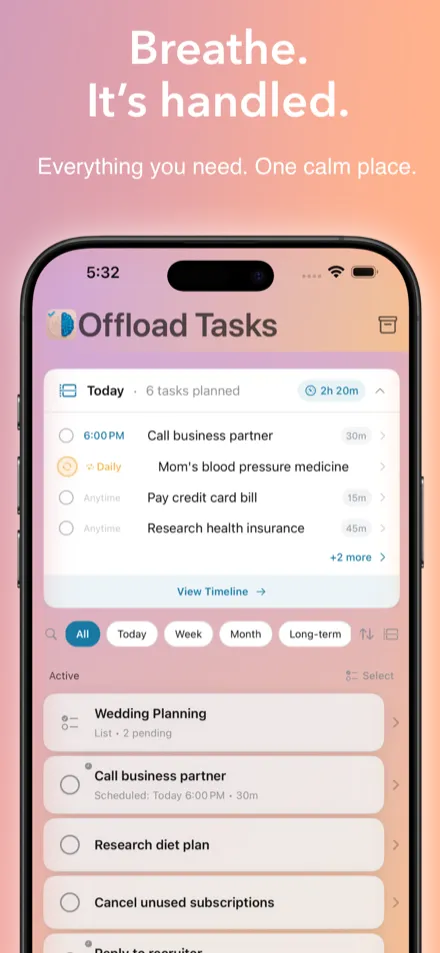
Offload was built with the Zeigarnik Effect in mind. Not as a feature, but as a philosophy. Every design decision serves one goal: to be the trusted system your brain can rely on, so your mind can finally release the loops it has been holding.
Instant capture. Adding a thought to Offload takes seconds. No required fields, no forced decisions about categories or priorities. Just get it out of your head. That alone begins closing the loop.
Gentle reminders. Offload brings tasks back to you at the right time. Not with alarming notifications or guilt-laden badges, but with calm, reliable nudges. Your brain learns that what goes into Offload comes back when it matters.
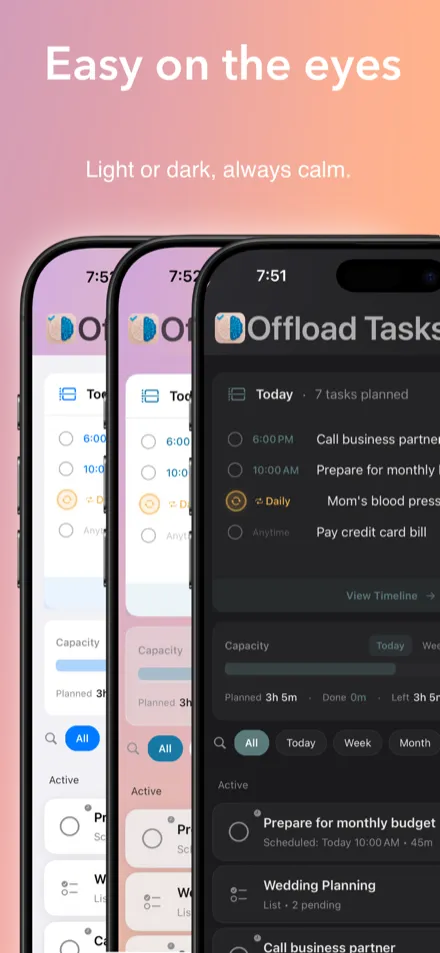
Capacity planning. Offload shows you how much you have planned for a given day. This is not about pressure. It is about preventing the overload that creates new open loops. When you can see that tomorrow is already full, you stop adding to it, and the loops stay manageable.
No complexity tax. There is no elaborate system to maintain. No intricate project hierarchies or multi-step workflows. Offload stays simple because simplicity is what makes a system trustworthy. The less you have to think about the tool, the more your brain trusts it.
Calm design. The interface does not create new anxiety. There are no red badges, no overdue counts, no streaks to maintain. Opening the app feels like setting things down, not picking up new burdens. This matters because a system that causes stress cannot simultaneously relieve it.
The result is a quiet exchange. You give your thoughts to Offload. Offload holds them reliably. And your brain, finally trusting that the loops are handled, lets them go. Not because the work is done, but because the plan exists in a place your mind believes in.
"You do not need to finish everything to find peace. You need to trust that everything is captured."
Closing the Loops
The Zeigarnik Effect is not a bug. It is a deeply useful cognitive feature that helped our ancestors track important commitments in a simpler world. The problem is not the effect itself, but the mismatch between this ancient system and our modern reality of endless tasks and constant inputs.
The solution is not to fight your brain or to develop more willpower or to try harder to remember everything. The solution is to work with the way your mind naturally operates. Give it a trusted external system. Let it release the loops it was never designed to hold in such quantity.
When you externalize your tasks into a system you genuinely trust, something shifts. The 3 AM thoughts quiet down. The background hum of undone things fades. The mental space that was occupied by open loops becomes available for the things that actually matter: focus, creativity, presence, rest.
That is what cognitive offloading means. Not doing more. Holding less. And finally giving your mind the permission to be still.
Close the Open Loops
Offload gives your brain a trusted place to let go. Fast capture, gentle reminders, no guilt mechanics. Just relief.