GTD Made Simple
You do not need contexts, weekly reviews, or a complex system. You need the one GTD principle that actually works.
The Brilliance of GTD
David Allen's Getting Things Done is one of the most influential productivity systems ever created. Its core insight is profound and scientifically supported:
"Your mind is for having ideas, not holding them."
The premise is simple. Every unfinished task, every half-formed plan, every thing you are trying to remember occupies mental bandwidth. Psychologists call this the Zeigarnik effect: your brain cannot let go of incomplete tasks. They loop in the background, draining energy and creating a low hum of anxiety.
Allen's solution: get everything out of your head into an external system you trust. Once your brain believes the system will remind you at the right time, it can finally let go.
This is a genuinely life-changing idea.
"The problem is not that GTD does not work. It is that the system around the insight is often harder to maintain than the tasks themselves."
Where GTD Gets Heavy
Full GTD requires five steps: capture, clarify, organize, reflect, and engage. In practice, this means:
- Contexts — tagging tasks by where you can do them (@home, @computer, @phone, @errands)
- Next Actions vs Projects — distinguishing between multi-step goals and their immediate next physical action
- Someday/Maybe lists — maintaining a separate list for things you might do eventually
- Weekly Reviews — sitting down every week to review every list, every project, every context
- Reference filing — organizing non-actionable information
Each piece makes sense. Together, they create a system that takes real effort to maintain. For many people, the overhead of managing the system starts competing with actually doing the work.
The One Principle That Matters
If you strip GTD down to its essence, one principle does most of the heavy lifting:
Capture the thought immediately, into a system you trust, and let your brain stop holding it.
That is it. Not contexts. Not weekly reviews. Not next actions versus projects. Just: get it out of your head fast, know it is safe, and move on.
Research supports this. A study by Masicampo and Baumeister (2011) found that simply making a plan to complete unfinished tasks — writing them down with a when and where — was enough to eliminate the cognitive burden. You do not need to do the task. You just need to trust that you will be reminded.
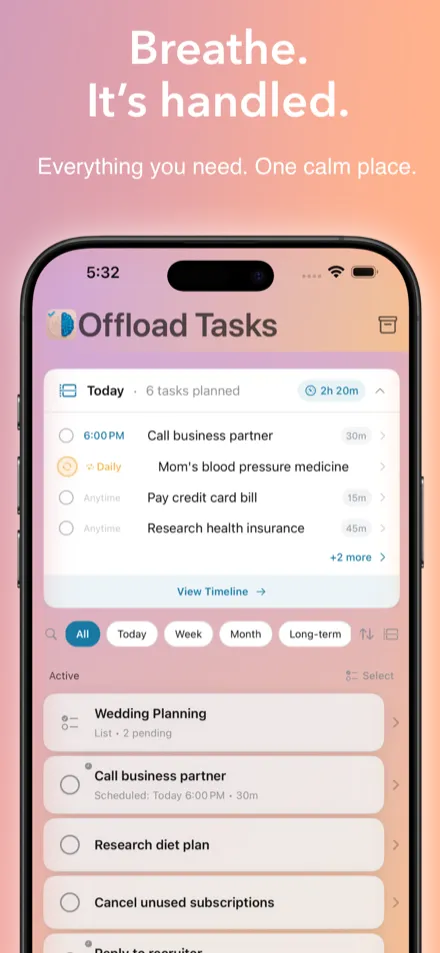
This is exactly what Offload is built for.
How Offload Delivers the GTD Core
Capture in under three seconds. Open the app, type your thought, close the app. No mandatory categories, no required due dates, no decisions. The thought is safely stored.
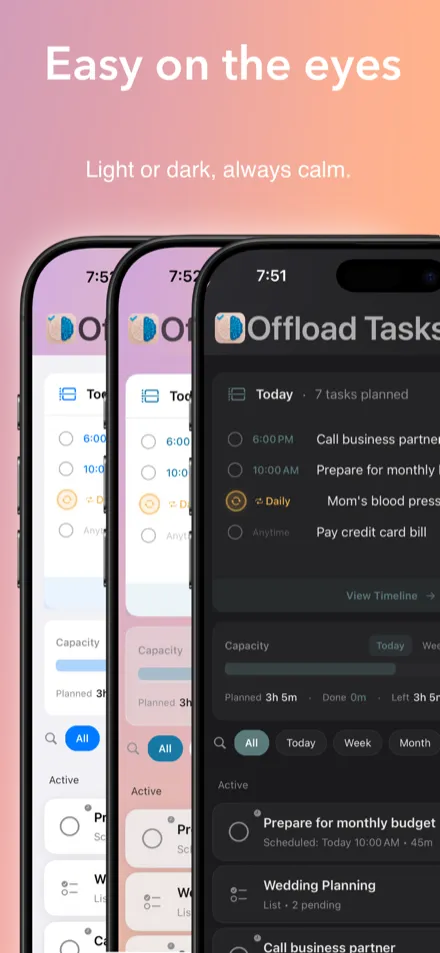
Trust through reminders. Set a reminder and your brain can truly let go. It knows the app will bring the thought back at the right moment.
No system to maintain. There are no contexts to set up, no weekly reviews to schedule, no filing systems to organize. The app holds your thoughts. You get them back when you need them.
This is GTD's most powerful principle, delivered without the overhead that causes most people to quit.
GTD vs Offload: What Stays, What Goes
| GTD Concept | In Offload? | Why |
|---|---|---|
| Capture everything | Yes | Core principle. Under 3 seconds, only title required. |
| Trusted system | Yes | iCloud sync, reminders, nothing gets lost. |
| Contexts (@home, @work) | Optional | Categories and tags exist but are never required. |
| Next Actions | Simplified | Lists with checkable items. No project/action distinction forced. |
| Weekly Review | Gentle version | Morning and evening check-in reminders. No formal review ritual. |
| Someday/Maybe | Yes | Time horizons include "Someday" — ideas without pressure. |
| Two-Minute Rule | No | Your choice. The app does not tell you what to do now. |
| Reference filing | No | Offload is for actionable thoughts, not reference storage. |
"Offload is not anti-GTD. It is GTD distilled to the principle that actually helps people who could not maintain the full system."
Capacity: The Feature GTD Forgot
GTD tells you to capture everything, but it never asks: how much can you actually handle today?
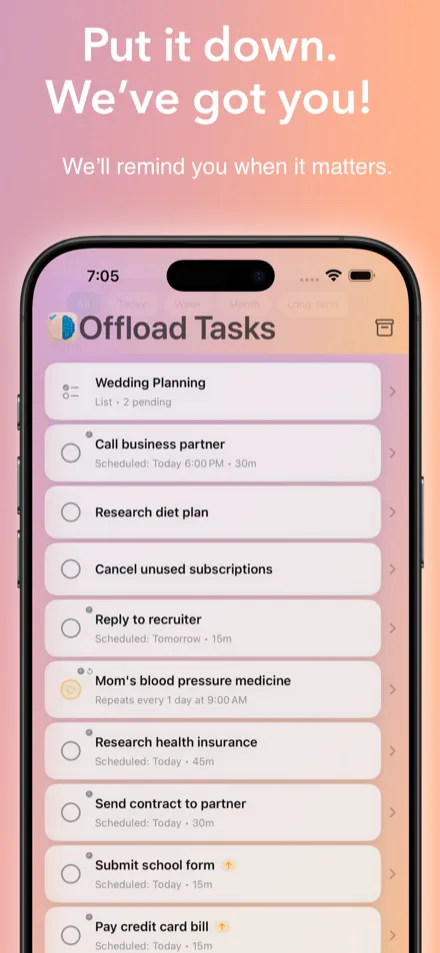
Offload includes a capacity meter. It shows how much you have planned for today, this week, and this month. Not as a target to hit, but as a gentle reality check.
Allen talks about "mind like water" — a state of calm readiness. But calm is hard to achieve when you have planned twelve hours of work for a six-hour day. Seeing your capacity visually helps you plan realistically before the overwhelm hits.
Who This Is For
You might have tried GTD and loved the idea. Maybe you set up OmniFocus or Todoist with contexts and projects. Maybe it worked for a few weeks, even a few months. But eventually the weekly reviews slipped, the contexts felt artificial, and the system became another thing on your to-do list.
Or maybe you never tried full GTD but you recognize the problem it solves. Your mind races with things you need to remember. You lie awake thinking about tomorrow. You feel busy but never done.
Offload is for you. It gives your thoughts a safe place to rest, without asking you to maintain an elaborate system to keep them organized.
GTD's Best Idea, Without the Overhead
Capture your thoughts. Trust the system. Let your mind rest.