5 Signs Your To-Do App Is Making You Anxious
Your productivity tool was supposed to help. But somewhere along the way, it became part of the problem.
The Quiet Irony of Productivity Apps
You downloaded a to-do app to get organized. To feel on top of things. To stop the constant mental chatter about what needs doing and when. And for a while, maybe it worked. You added tasks, checked things off, and felt a small sense of control.
But over time, something shifted. Opening the app started to feel heavy. The list grew faster than you could work through it. The notifications became a source of dread rather than helpful nudges. And the app that was meant to bring calm became another thing demanding your attention.
If this sounds familiar, you are not alone. Research into task anxiety shows that the design choices in productivity tools can directly contribute to stress. Not because you are doing anything wrong, but because many apps are built around pressure, not peace.
Here are five signs your to-do app might be making your anxiety worse, not better.
You Dread Opening the App
This is the most telling sign. If the thought of tapping that icon fills you with a quiet sense of unease, your app has crossed a line. It has gone from being a tool to being a stressor.
Many apps greet you with a count of overdue tasks. A red badge sits on the icon, growing larger every day you avoid it. The home screen becomes an accusation: "You have 23 overdue tasks." Before you have even started your day, you feel behind.
This design choice is intentional. It creates urgency. But for people who are already stretched thin, urgency does not motivate. It paralyzes. The badge becomes a reason to avoid the app entirely, which means tasks pile up further, which makes the badge grow, which increases the dread. It is a cycle with no good exit.
A task app should feel like a safe place to set things down. If opening it feels like facing a judgment, the app is failing at its most basic purpose.
You Feel Guilty About Rescheduling
Plans change. This is not a character flaw. It is the nature of life. But many task apps treat rescheduling as a failure. They mark tasks as "overdue" the moment the date passes. They show you how many times you have postponed something. Some even use language like "snoozed again" with a tone that implies disappointment.
This punitive design teaches you that changing your mind is bad. That if you planned something for Tuesday and it did not happen, you have let yourself down. Over time, you start to internalize this. Rescheduling stops being a practical decision and starts feeling like evidence that you are not doing enough.
The truth is, rescheduling is just planning with new information. A calm system treats it that way.
Streaks Control Your Behavior
Streaks are one of the most common gamification patterns in productivity apps. Complete tasks every day, keep your streak alive. Miss a day, and the counter resets to zero. It sounds harmless. It is not.
Streaks exploit loss aversion, the psychological principle that losing something feels worse than gaining the equivalent. Once you have a 30-day streak, the fear of breaking it becomes the primary motivator, not the actual value of the tasks you are completing. You start doing things not because they matter, but because the streak demands it.
This is how a tool starts controlling you instead of serving you. You might complete a low-priority task just to keep the streak alive while ignoring what actually needs your attention. Or you might feel genuine distress on a day when you are sick, or tired, or simply need rest, because the streak is in danger.
Streaks are a form of cognitive load. They add another thing to worry about, another number to maintain, another way to fail. Your worth is not measured in consecutive days of task completion.
"If your task app makes rest feel like a failure, it is optimizing for the wrong thing."
You Are Maintaining the System More Than Using It
Some task apps are so feature-rich that managing them becomes a task in itself. You spend time organizing projects, adjusting priorities, tagging and re-tagging, moving tasks between views, configuring filters, and tweaking settings. The app demands that you maintain its system before you can use its system.
This is the complexity tax. Every feature adds cognitive overhead. Every setting is a decision. Every organizational scheme requires upkeep. At some point, the time you spend managing your tasks overtakes the time you spend doing them.
If you have ever spent 20 minutes reorganizing your to-do list and then felt too drained to actually start working, you have experienced this firsthand. The tool has become the work.
Completing Tasks Brings No Relief
This might be the most disheartening sign. You check something off, and instead of feeling lighter, you feel nothing. Or worse, you immediately notice the ten things still remaining. The list never gets shorter. There is always more.
This is the endless list syndrome. Traditional to-do apps are designed to hold everything. Every thought, every obligation, every maybe-someday idea. The result is a list that never reaches zero. And because the list is always there, always visible, always growing, completion of individual tasks provides no emotional relief.
Psychologically, this is corrosive. Humans need a sense of progress to maintain motivation. When the finish line keeps moving, when every completed task reveals three more behind it, the experience becomes demoralizing rather than satisfying. You stop associating task completion with accomplishment and start associating it with futility.
A well-designed system limits what you see. It shows you what matters today, not everything that has ever crossed your mind. It creates natural boundaries that let you experience the feeling of being done, even temporarily.
What a Calmer Alternative Looks Like
If you recognized yourself in any of these signs, the problem likely is not you. It is the design of the tool. Here is what to look for in an app that respects your mental health:
- No overdue badges or guilt mechanics. Tasks wait patiently. They do not accuse you of falling behind.
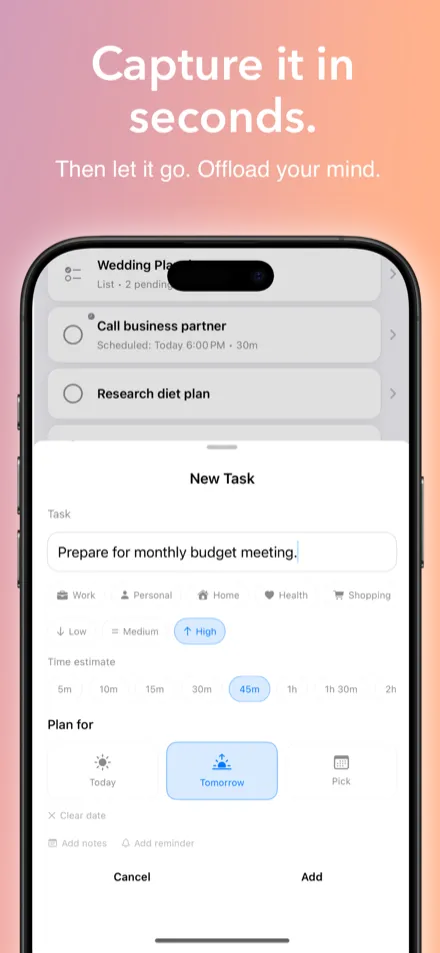
- Effortless capture. Getting a thought out of your head should take seconds, not decisions. No required fields, no forced categorization.
- Easy rescheduling without shame. Moving a task to tomorrow should feel as natural as turning a page. No "snoozed again" counters.
- No streaks or gamification. Your motivation should come from your own values, not from an app's scoring system.
- Simplicity over features. A calm interface that stays out of your way. No complexity tax.
- Capacity awareness. A gentle signal when you are planning more than you can handle, before the overwhelm sets in.
- Calm language. Neutral, supportive phrasing. No urgency, no judgment, no "you should" statements.
These are not luxury features. For people who experience task management challenges, they are essential. The design of your tools shapes your emotional experience of work and life. Choosing a calmer tool is not laziness. It is self-awareness.
"The best task app is one that makes you feel safe, not surveilled."
Ready for a Calmer Approach?
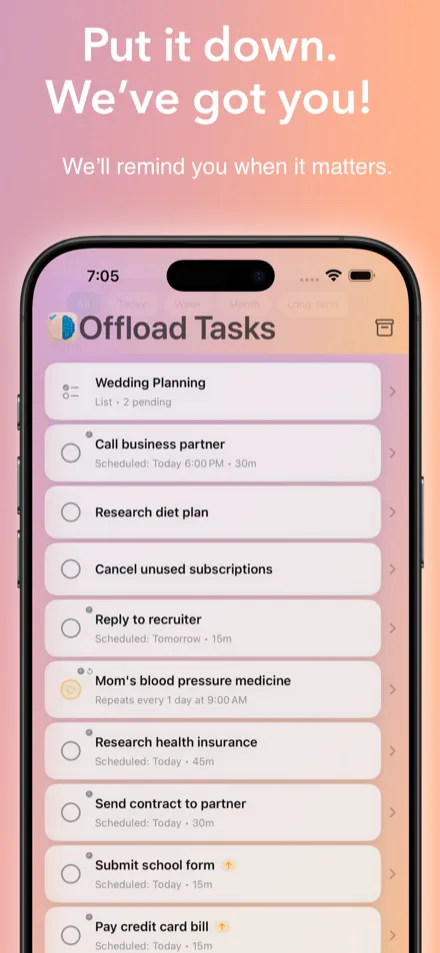
Offload is designed for mental relief, not maximum output. No streaks. No guilt. Just a quiet place to set things down.