Sunday Scaries: Why the Week Ahead Feels So Threatening
The dread is not about Monday. It is about everything your brain is trying to hold without a place to put it down.
That Sinking Sunday Feeling
It is Sunday afternoon. The light outside has shifted, gone golden and low, and the hours feel like they are accelerating. The weekend, which stretched out so generously on Friday evening, has contracted to a narrow sliver. You are on the couch, or maybe walking the dog, or trying to finish a chapter of a book. But you are not really there. Something has settled into your chest, heavy and formless, a weight you cannot name but cannot ignore.
It started as a whisper around lunchtime. A flicker of something. By mid-afternoon, it has grown into a low, persistent hum that colors everything. The remaining free hours feel counterfeit. You are technically still off, but your mind has already left the weekend behind. It is somewhere in Monday, or maybe the whole week, scanning the days ahead for threats it cannot quite identify.
The restlessness sets in. You pick up your phone and put it down. You open the fridge and close it. You snap at someone over something trivial and immediately feel guilty about it. Or maybe you go quiet, retreating into a scroll through social media that absorbs nothing, just motion to fill the space where peace used to be. The evening arrives and brings no relief. Bedtime comes, and sleep does not. You lie in the dark turning over fragments: the project you are behind on, the conversation you have been avoiding, the errand that has been on your list for two weeks, the thing someone mentioned on Friday that you were supposed to follow up on but cannot quite remember.
This is the Sunday Scaries. And if you experience them, you are in the majority. Surveys consistently find that more than three-quarters of working adults report significant anxiety on Sunday evenings. It is one of the most common and least discussed forms of recurring stress in modern life.
What the Sunday Scaries Actually Are
The Sunday Scaries are a form of anticipatory anxiety, the mind's attempt to prepare for a future that feels uncertain and potentially overwhelming. This is not the same as worrying about a specific event, like a presentation you have to give or a difficult conversation you are dreading. It is broader than that, more diffuse. It is your brain trying to preview an entire week of demands without having a clear picture of what those demands actually are.
Research on anticipatory anxiety shows that the brain responds to uncertainty about future threats with many of the same stress responses it uses for present danger. The amygdala activates. Cortisol rises. The body tenses and prepares, even though there is nothing concrete to prepare for. You are lying on your couch on a quiet Sunday evening, but your nervous system is bracing for impact as though Monday were already happening.
What makes anticipatory anxiety particularly exhausting is that it is open-ended. When you face a real, concrete challenge, the stress response has a beginning and an end. You deal with the thing, and the tension resolves. But when the threat is vague, when it is "the week" rather than a specific task, the stress has no natural resolution point. Your brain cannot think its way to a solution because the problem has not been defined clearly enough to solve. So the anxiety just cycles, looping through the same shapeless dread without ever landing on something actionable.
This is why the Sunday Scaries feel so disproportionate to reality. The upcoming week may be entirely manageable. But because your brain is working with incomplete information, it defaults to worst-case projections. It fills in the blanks with threat. It assumes that everything it cannot see clearly is dangerous. And so you end up spending Sunday evening anxious about a Monday that, in reality, might be perfectly fine, if only you could see it clearly.
"The Sunday Scaries are not about Monday. They are about everything your brain is trying to hold that has not been written down."
The Invisible Task List
If you look closely at what actually drives the Sunday Scaries, you will find that the core issue is not the week itself. It is the invisible task list: the collection of unprocessed commitments, unresolved obligations, and half-formed plans floating in your head without structure, priority, or a home.
Think about what accumulates over a typical week. Some tasks get completed and disappear. Others get partially done and then deferred to an unspecified "later." New things arrive constantly via email, conversation, text message, or sudden memory. Vague commitments stack up without being captured anywhere concrete: "I should really get to that," "I told them I would look into it," "I need to figure out what to do about..." Each one of these is an open loop, a mental thread your brain is holding without resolution.
By Sunday evening, these loops have reached critical mass. Your brain, which has been suppressing them during the weekend's distractions, movies, social plans, errands, the pleasant business of not-working, can no longer hold them back. They surface all at once in a disorganized flood. Not as a neat list you can work through, but as a feeling, a weight, an unnamed dread that sits in your chest and will not explain itself.
This is the Zeigarnik Effect operating at scale. Psychologist Bluma Zeigarnik demonstrated in the 1920s that unfinished tasks occupy the mind more persistently than completed ones. The brain treats each open loop as an active commitment that requires ongoing monitoring. It keeps the loop cycling through working memory, surfacing it at unexpected moments, refusing to let it fade until the commitment is resolved or reliably externalized. A single unfinished task is a mild irritant. Dozens of them, accumulated over days and weeks without being written down or addressed, create the crushing cognitive weight that the Sunday Scaries are made of.
The dread you feel on Sunday evening is not irrational. It is your cognitive system telling you, with complete accuracy, that it is holding more than it was designed to manage. The alarm is real. It is just poorly directed, because the problem is not the week ahead. The problem is the unprocessed backlog living in your working memory with nowhere else to go.
Why "Just Relax" Does Not Work
The most common advice for the Sunday Scaries is some variation of "try to relax" or "stop thinking about work." This advice is well-intentioned and almost entirely useless. Worse, it can make things harder.
Telling your brain to stop thinking about open loops is like telling yourself not to think about a white bear. The psychologist Daniel Wegner studied this phenomenon extensively and called it ironic process theory: actively trying to suppress a thought increases the frequency with which it returns. The harder you try to enjoy your Sunday evening, the more aggressively the unresolved tasks demand your attention. Suppression is not a strategy your cognitive system respects.
The open loops are real. They represent actual commitments that have not been addressed, actual tasks that need doing, actual uncertainties that need resolving. Your brain knows this. It will not stop tracking them just because you would prefer it to. It needs resolution, not denial. It needs to know that the things it is holding are handled, not that you are choosing to ignore them.
This is also why relaxation techniques alone, meditation, baths, breathing exercises, often fail to address the Sunday Scaries at their root. These practices can reduce surface-level physiological tension, and they have real value. But they do not close the open loops that are driving the anxiety underneath. The moment the candle burns out and the bath drains, the loops are still there, patient and insistent. Your brain was not anxious because it needed to relax. It was anxious because it was holding too much without a plan for any of it.
A Sunday Evening Practice
The antidote to the Sunday Scaries is not relaxation. It is externalization. And it takes far less time than you might expect.
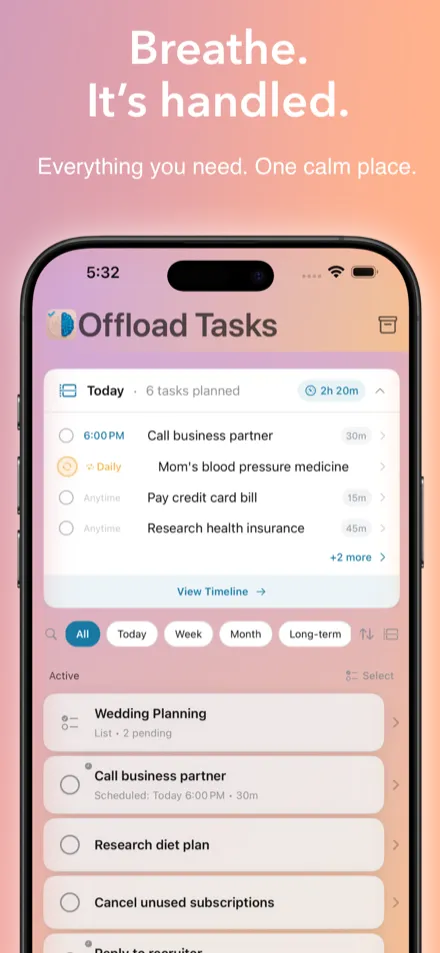
Here is the practice: on Sunday evening, set aside ten to fifteen minutes. Sit down with a trusted capture tool, whether that is an app on your phone, a notebook on your desk, or anything you know you will actually look at again. Then do a brain dump. Get everything out of your head. All of it. Not some of it. Everything.
Do not organize. Do not prioritize. Do not plan. Just capture. Write down every single thing that is floating in your mind about the week ahead, and about the weeks before it that are still lingering:
- Tasks you know need to happen this week
- Things you have been putting off that are starting to nag
- Commitments you made to other people
- Appointments or deadlines you are aware of
- Vague obligations you have not pinned down yet but feel the weight of
- Leftover items from last week that never got done
- Anything at all that is taking up mental space, even if it seems small
The goal is not to create a perfect plan for the week. That would be its own form of pressure, and it would likely make the anxiety worse by showing you the full scope of everything at once. The goal is simply to move everything from your working memory into an external system. To transform the invisible task list, the one causing the dread, into a visible one.
Something remarkable happens when you do this honestly and completely. The weight lifts. Not because the tasks have gone away, and not because the week has gotten any easier. It lifts because your brain is no longer solely responsible for holding all of those threads. The open loops begin to close, not because the work is done, but because each item now exists in a place your brain can trust. Research by Masicampo and Baumeister has shown that simply making a concrete plan for an unfinished task reduces the intrusive thoughts associated with it, even if the task itself remains undone. Externalization functions as that plan. It tells your brain: this is handled. You can let go.
After the brain dump, you can glance at the list and ask one simple question: is there anything here that genuinely needs my attention first thing Monday morning? If so, note it. If not, close the list. You are done. The week has been externalized. Your brain has permission to stand down. And Sunday evening, finally, belongs to you again.
"Ten minutes of honest externalization on Sunday evening can buy you hours of peace."
How Offload Supports This
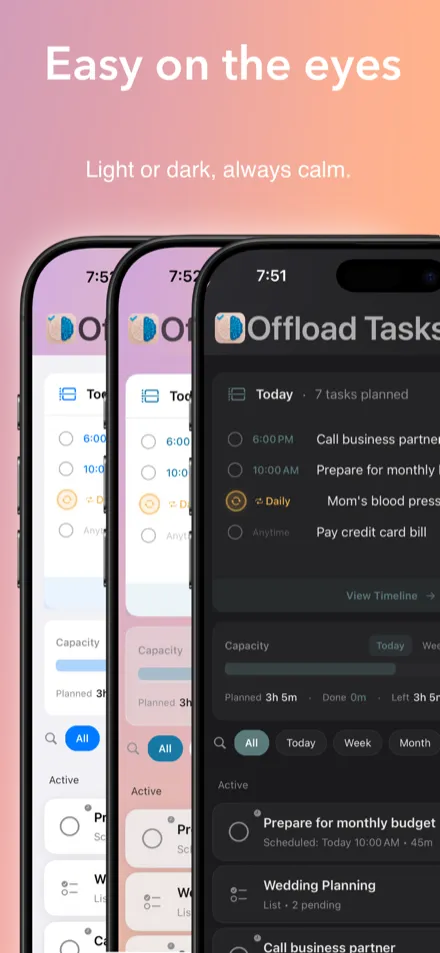
Offload was designed for exactly this kind of moment. When your mind is full and you need to set things down quickly, without friction, without being forced into decisions you are not ready to make.
Fast capture for the brain dump. Adding a task to Offload takes seconds. There are no required fields, no mandatory categories, no priority levels to deliberate over. Just type the thought and let it go. When you are doing a Sunday evening brain dump, this speed matters enormously. The lower the friction, the more completely you can empty your mind. Every extra tap or decision point is an invitation to stop capturing and start worrying again.
Capacity view to see the week honestly. Once your tasks are externalized, Offload shows you your capacity for the days ahead. This transforms the vague, threatening sense of "the week is going to be too much" into something concrete and assessable. Maybe it is overloaded. Maybe it is not. Either way, you can see it now instead of just feeling it. And if the week genuinely is too full, you can make adjustments on Sunday evening, calmly, before the chaos of Monday morning forces those decisions on you.
Gentle morning reminders that carry the load forward. After your brain dump, you do not have to hold the whole week in your head. Offload brings the right tasks forward each morning. Monday shows you Monday. Tuesday shows you Tuesday. Your brain does not need to track what is coming on Thursday while you are trying to sleep on Sunday night, because the system is tracking it reliably. This is what allows the Sunday anxiety to dissolve: the knowledge that each day will be handled as it arrives, without you having to mentally rehearse it in advance.
No guilt, no pressure, no judgment. Offload does not punish you for having a long list. It does not turn your brain dump into a scoreboard. It simply holds what you give it and brings it back when it matters. This calm reliability is what makes it possible to do the brain dump honestly, without the fear that writing everything down will just create a new, more detailed source of anxiety.
Reclaiming Sunday Evenings
The Sunday Scaries persist because they feed on invisibility. When the week ahead is a shapeless mass of potential demands, undefined and unexamined, your brain has no choice but to treat it as a threat. It cannot assess what it cannot see. And so it assumes the worst, flooding your body with stress hormones and your mind with worst-case scenarios, all in response to a week that has not even started yet.
The fix is not to feel less. It is to see more. When you externalize your tasks, the invisible becomes visible. The unmanageable becomes a list, and a list is something you can look at, assess, and respond to with clarity instead of dread. Your brain stops running threat simulations because it no longer needs to. The information is out in the open, concrete and finite. There are edges to it now. It is no longer the infinite, formless "everything" that was crushing you. It is a specific, bounded set of things, and specific, bounded things are manageable.
This does not mean the week will be easy. Some weeks are genuinely hard, and no amount of externalization changes the actual workload. But there is an enormous difference between facing a hard week with clarity and facing one with dread. Clarity lets you prepare, prioritize, and make real decisions about what matters. Dread just consumes the hours you could have spent resting, leaving you exhausted before Monday even begins.
Sunday evenings can become something different. Not the end of freedom. Not a prolonged anxiety attack about days that have not arrived. Just a brief, quiet moment of transition. Ten minutes to set things down. A glance at what is ahead. And then the rest of the evening is actually yours, fully and genuinely yours, because your brain has what it needs to let go.
The week will come regardless. The only question is whether you meet it having already made the invisible visible and the unmanageable manageable, or whether you let it arrive as a wave of unnamed anxiety that stole your Sunday night and your Monday morning sleep. One path costs you ten minutes. The other costs you an entire evening and often a night of rest along with it.
Put it down. All of it. Your mind will thank you when Monday comes.
Reclaim Your Sundays
Offload gives your brain a place to put everything down. Fast capture, capacity awareness, and zero guilt. Start the week lighter.