Emotional Exhaustion
Feeling drained before the day even starts. The alarm goes off and you already feel behind, not because of what is ahead, but because recovery never fully happened.
When keeping up stops working, it is not a sign of weakness. It is a signal that the demands on your mental energy have exceeded your capacity to recover.
Burnout is not a dramatic collapse. There is no single moment where everything falls apart. Instead, it is a slow erosion of energy that happens when the demands on your mind consistently exceed your ability to recover.
This is what quiet burnout looks like: you are still functioning. You still show up. You still get things done. But everything feels harder than it used to. Tasks that once felt manageable now feel heavy. Mornings that once felt neutral now feel like a weight before the day has even started.
You have not suddenly become less capable. Your capacity has been quietly drained, day after day, without enough space to refill.
Quiet burnout does not always announce itself. It settles in gradually, disguised as tiredness or a "rough patch." These are the patterns to notice:
Feeling drained before the day even starts. The alarm goes off and you already feel behind, not because of what is ahead, but because recovery never fully happened.
Things that were easy now feel heavy. Simple decisions take more effort. Small tasks feel disproportionately large. Your threshold for what you can handle has quietly shrunk.
Going through the motions without engagement. You complete tasks but feel disconnected from them. The work gets done, but the sense of meaning or satisfaction has faded.
Difficulty concentrating, making decisions, or thinking clearly. Your mind feels sluggish, not because you are not trying, but because mental resources are depleted.
"Burnout is not a failure of willpower. It is what happens when the demands on your mind exceed your ability to recover."
Chronic overwhelm is not random. It follows a pattern, and understanding that pattern is the first step toward breaking it.
It starts with overcommitment. You take on more than you can comfortably handle, often without realizing it. Each individual commitment seems reasonable. But the total weight is more than you can carry.
Then you fall behind. Not dramatically, but enough to notice. Small things slip. You start carrying a low-grade anxiety about what you might be forgetting.
Guilt follows. You feel like you should be able to handle this. Other people seem to manage. So you push harder, work longer, rest less. You try to outrun the feeling.
But pushing harder does not solve overcommitment. It deepens it. You burn through more energy without addressing the root cause. The cycle tightens: overcommit, fall behind, feel guilty, push harder, burn out more.
Productivity culture makes this worse. It frames rest as laziness and capacity limits as obstacles to overcome. It tells you the answer is always to do more, optimize more, hustle more. But when the problem is too much, more is not the answer.
The first step toward breaking the overwhelm cycle is honest awareness of your capacity. Not the capacity you wish you had, or the capacity you think you should have, but the capacity you actually have right now.
This is harder than it sounds. We are conditioned to treat our limits as problems to solve rather than realities to respect. But you cannot pour from an empty cup, and pretending otherwise does not make the cup any fuller.
Reducing your mental load is not giving up. It is not admitting defeat. It is self-preservation. It is the recognition that protecting your capacity today is what allows you to show up tomorrow.
Recovery is not earned through exhaustion. It is something you protect deliberately, before you reach the point where you have nothing left.
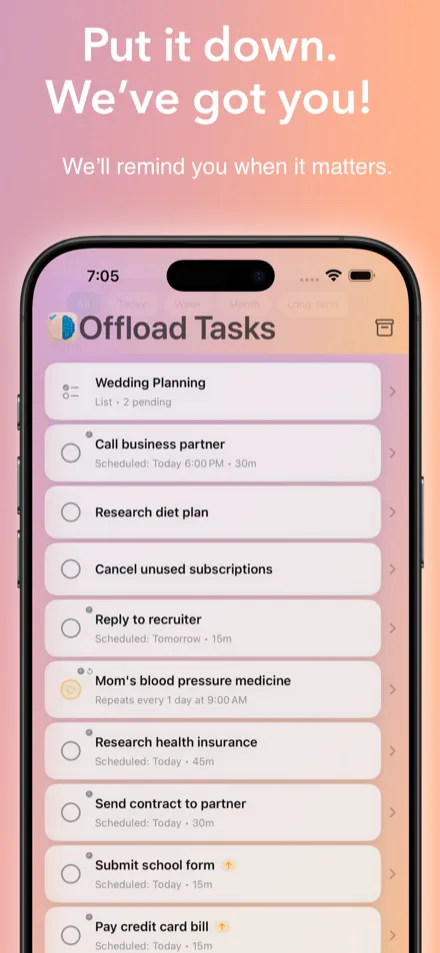
Offload is designed around a simple idea: you should be able to see your limits clearly, before they become a crisis.
See when you are overcommitted before it hurts. Offload makes the invisible weight of your commitments visible, so you can make honest decisions about what fits.
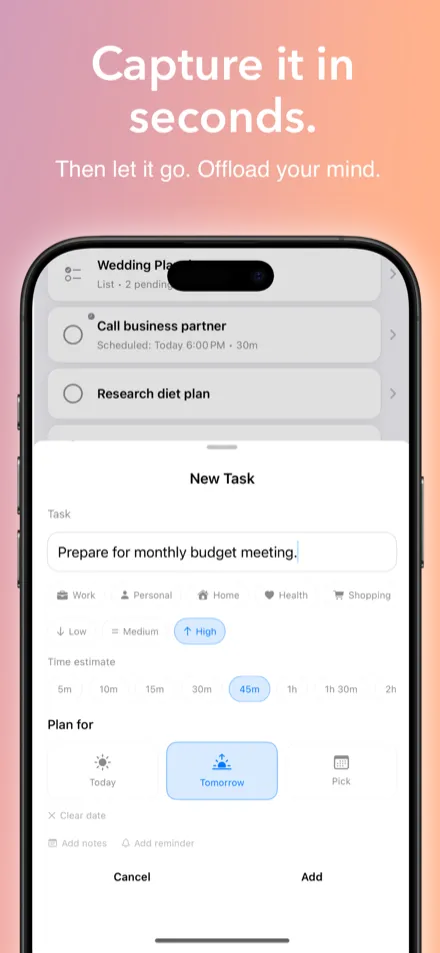
Move tasks without shame. Plans change, energy fluctuates, and some days are harder than others. Rescheduling is not failure. It is honest planning.
No streaks, no scores, no metrics. Offload does not track how much you accomplish or make you feel behind. It exists to reduce pressure, not create it.
Gentle nudges, not alarm bells. When Offload reminds you of something, it is a quiet tap on the shoulder, not a siren. You stay informed without being overwhelmed.
"Recovery is not something you earn. It is something you protect."
Offload helps you see your limits clearly, so you can protect what matters most.