Shutdown Anxiety: Why You Cannot Stop Working at the End of the Day
Your body leaves work but your mind stays behind. Understanding why your brain refuses to disconnect is the first step toward reclaiming your evenings.
The Day That Never Ends
It is 6:47 PM. You have closed the laptop. The screen is dark, the desk is still, and the workday is technically over. But somewhere behind your eyes, a second workday is already running. You pick up your phone and check email one more time. Nothing urgent. You put the phone down. Twenty seconds later, you pick it up again.
At dinner, you are sitting across from the people who matter most to you, but you are not really there. Someone is telling a story about their day. You nod and smile, but behind the smile you are mentally composing a reply to a message you received at 4 PM. You are replaying a conversation from a meeting, refining what you should have said. You are building a mental list of everything that needs to happen tomorrow, because if you stop holding it in your head right now, you are afraid it will vanish.
Later, on the couch, you try to watch something. You last about ten minutes before the phone is in your hand again. Not because anything has changed, but because the pull is automatic, reflexive, almost physical. The evening passes and you never quite arrive in it. Your body stopped working hours ago. Your mind never did.
This is shutdown anxiety. It is the inability to mentally disconnect from work after you have physically stopped. And if it sounds familiar, you are far from alone. It is one of the most common and least discussed sources of chronic stress in modern life.
Why Your Brain Will Not Shut Down
The instinct is to blame yourself. You tell yourself you lack discipline, that you are too attached to work, that you need better boundaries. But shutdown anxiety is not a character flaw. It is a predictable neurological response to unresolved commitments.
Your brain has an ancient monitoring system designed to track anything that represents an open commitment: an unfinished task, an unanswered question, an incomplete plan. This system keeps those items active in your awareness, cycling them through working memory on a low-level loop, until the commitment is resolved. This is the same mechanism behind the Zeigarnik Effect, the well-documented finding that unfinished tasks occupy the mind far more persistently than completed ones.
When you close your laptop at the end of the day, the screen goes dark but the open loops do not. Every email you did not reply to, every task you pushed to tomorrow, every half-formed plan and ambiguous next step remains active in your brain's monitoring system. Your mind treats each one as a small, unresolved threat that requires continued vigilance.
This is not work addiction. It is not a failure of willpower. It is a threat response. Your brain is doing exactly what it evolved to do: tracking unresolved commitments to keep you safe. The problem is that in modern work life, the number of open loops never actually reaches zero. There is always another email, another task, another thing that could be done. And so the monitoring system never stands down.
The result is a mind that cannot rest because, from its perspective, it is not safe to rest. There are still things out there that need watching.
"You are not addicted to work. Your brain just does not trust that it is safe to stop."
The Cost of Never Disconnecting
Shutdown anxiety might feel like a minor nuisance, just the background hum of a busy life. But research on psychological detachment, most notably by Sabine Sonnentag and Charlotte Fritz, reveals that the chronic inability to mentally disconnect from work has serious and compounding consequences.
Reduced recovery. Your body and mind need genuine downtime to restore the cognitive and emotional resources depleted during the workday. When your brain continues processing work during the evening, this recovery does not happen. You return to work the next morning already partially depleted, starting at a deficit that grows deeper with each passing day.
Impaired sleep. The racing thoughts that characterize shutdown anxiety directly interfere with sleep onset and sleep quality. Your brain remains in a state of low-level activation, monitoring open loops, which is fundamentally incompatible with the relaxation needed for restorative sleep. Over weeks and months, the sleep debt accumulates into something that no single good night can repay.
Relationship strain. The people around you can tell when you are not present. Even if you are physically in the room, the emotional absence created by a mind still at work erodes the quality of your connections. Partners feel unheard. Children sense the distraction. The evenings and weekends that are supposed to nourish your relationships become hollow versions of togetherness.
Diminished creativity. Creativity depends on the kind of loose, associative thinking that only happens when the mind is not actively problem-solving. When shutdown anxiety keeps your brain locked into work mode, you lose access to the diffuse thinking that generates your best ideas. The irony is sharp: the inability to stop working makes you measurably worse at work.
Burnout. All of these factors converge into a single trajectory. Without genuine recovery, without restorative sleep, without nourishing relationships, without creative renewal, the path leads to burnout. Not because the work itself is too much, but because the mind never gets permission to set it down.
The Shutdown Ritual
Computer scientist and author Cal Newport proposed a practice he calls the "shutdown complete" ritual: a deliberate sequence of actions performed at the end of each workday that signals to the brain it is safe to disengage. The ritual is simple, but it is powerful because it directly addresses the root cause of shutdown anxiety: unresolved open loops.
The steps are straightforward:
- Review every open task. Look at your task list, your inbox, your calendar. Make sure nothing has been missed or forgotten. The brain needs evidence that you have surveyed the full landscape of your commitments.
- Capture anything floating. If there are thoughts, concerns, or to-dos lingering in your mind that have not been written down, externalize them now. Get them out of your head and into a system you trust.
- Confirm tomorrow's plan. Glance at what is scheduled for tomorrow. You do not need a detailed hour-by-hour plan. You just need enough to reassure your brain that future you will know what to do when the time comes.
- Declare the workday over. Newport suggests saying a specific phrase, something like "shutdown complete," as a deliberate cognitive marker. This sounds almost comically simple, but the explicit declaration gives your brain a clear signal: the monitoring can stop now.
The ritual works because it provides the brain with what it has been asking for all along: proof that nothing has been dropped. Every open loop is either resolved or captured. Tomorrow is accounted for. The threat-monitoring system can finally stand down.
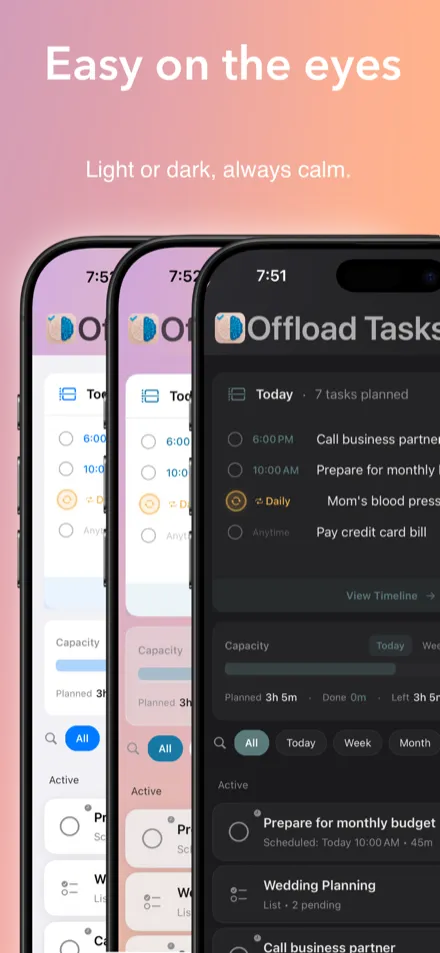
"A clean shutdown is not about finishing everything. It is about trusting that everything is captured."
Why a Trusted System Makes It Work
There is a critical catch with the shutdown ritual. It only works if the system you are externalizing into is one your brain actually trusts.
Think about what happens when you write a task on a sticky note and press it to the edge of your monitor. You might feel a brief moment of relief. But deep down, part of your mind knows that sticky note could fall off, get buried under papers, or simply be forgotten by tomorrow morning. The open loop does not fully close because the externalization was not convincing.
The same thing happens with unreliable apps, disorganized notebooks, or systems you only check sporadically. Your brain is paying closer attention than you realize. It tracks not just the tasks themselves but your track record with the system. If you have a history of writing things down and then not following through, your brain learns to keep the loops open regardless. The act of writing becomes a hollow gesture that provides no real relief.
A trusted system earns that trust through consistency. It must be fast enough that you actually use it every time a thought surfaces. It must be reliable enough that things you capture genuinely come back to you at the right moment. It must be simple enough that maintaining the system does not become yet another source of cognitive load. And it must be accessible enough that you can reach it whenever thoughts arrive, not just when you are sitting at your desk.
When all of these properties are present, something remarkable happens during the shutdown ritual. As you review your tasks and capture your lingering thoughts, your brain recognizes that this is not just going through the motions. Everything is genuinely handled. The loops actually close. And the monitoring system finally stands down for the night.
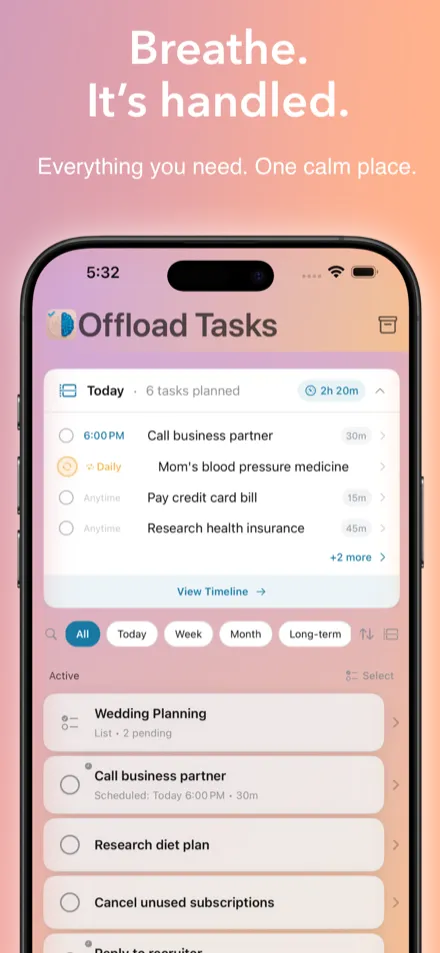
How Offload Enables Clean Shutdowns
Offload was designed to be the kind of system your brain can genuinely rely on, the system that makes the shutdown ritual actually work.
Quick end-of-day brain dump. When you sit down for your shutdown ritual, adding every lingering thought to Offload takes seconds. No forced categories, no required fields, no decisions that slow you down. Just get it out of your head. The speed of capture means nothing gets skipped and nothing stays in your mind because it was too much friction to record.
Tomorrow at a glance. Offload shows you what is planned for tomorrow with capacity awareness built in. During your shutdown review, you can see not just what is scheduled but whether it is realistic. This gives your brain the reassurance it needs: tomorrow is accounted for, and it is manageable.
Gentle evening review reminder. If you opt in, Offload sends a calm nudge in the evening, a reminder to do your shutdown check. Not a guilt-laden alert or an alarming notification, just a quiet signal that it is time to close the day. Over time, this builds the habit that makes the ritual automatic.
Everything synced and waiting. When you open Offload the next morning, everything you captured the night before is right there. Nothing lost, nothing forgotten, nothing left behind. Your brain learns this pattern quickly, and the trust deepens with every consistent experience. When the app holds it, you do not have to.
The Skill of Stopping
We live in a culture that celebrates relentless effort and treats the inability to stop working as a badge of dedication. But the truth is quieter and more important: the ability to stop, to genuinely disconnect, to be fully present in the hours that belong to the rest of your life, is itself a skill. And like any skill, it requires the right tools.
Shutdown anxiety is not a personal failing. It is the natural consequence of carrying too many open loops in a mind that was never designed to hold them all simultaneously. The solution is not more discipline. It is not tougher boundaries or a stronger will. The solution is giving your brain what it actually needs: a trusted external system that holds your commitments so reliably that your mind can finally release them.
When the last lingering thought is captured, when tomorrow's plan is visible and realistic, when you can close the app and know with genuine confidence that nothing will slip through the cracks, something shifts. The tightness in your chest dissolves. The phone stays on the table. The conversation at dinner comes into focus. The evening stops being an extension of the workday and starts being yours again.
The ability to stop working is not laziness. It is not indifference. It is the foundation of sustainable work and a meaningful life outside of it. A trusted system is the tool that makes it possible. And the day, at last, is allowed to end.
End the Day with a Clear Mind
Offload holds everything so your brain does not have to. Fast capture, calm evening reviews, and the peace of knowing nothing will be forgotten.